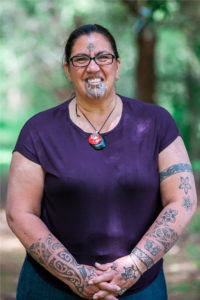
Leonie Pihama is a mother of six and a grandmother of five. She is a Professor of Māori Research at Ngā Wai a Te Tūī Research Institute at Unitec, and Director of Māori and Indigenous Analysis Ltd, a kaupapa Māori research company.
Leonie is a leading kaupapa Māori educator and researcher. She was a recipient of the Hohua Tūtengaehe Post-Doctoral Research Fellowship (Health Research Council) and the inaugural Ngā Pae o Te Marama Senior Māori Fulbright Scholarship at the University of Washington. In 2015, Leonie was awarded the Te Tohu Pae Tawhiti Award (NZARE) for excellence in Māori Educational Research and as Director of Te Kotahi Research Institute accepted the Te Tohu Rapuora Award (HRC) to recognise significant contribution to Māori health excellence and leadership.
Leonie has served on the Māori Health Committee for the Health Research Council, and on a number of key boards including: Māori Television, Te Māngai Pāho, and Ngā Pae of Te Māramatanga. She recently completed two Health Research Council projects, ‘He Oranga Ngākau: Māori Approaches to Trauma Informed Care’, and ‘Honour Project Aotearoa’. She is also working with Tu Tama Wahine o Taranaki Inc as an MBIE, He Punaha Hihiko: Vision Matauranga Capability Fund Placement recipient on the project ‘Titiro whakamuri, kokiri whakamua’, exploring land based healing practices for wahine in Taranaki as part of the Tangata Whenua Tangata Ora HRC Māori Health programme led by Whaariki Research Centre. Leonie is Principal Investigator with Professor Linda Tuhiwai Smith on He Waka Eke Noa: Māori Cultural Frameworks for Violence Prevention and Intervention.
 Linda Tuhiwai Smith is currently a distinguished Professor at Te Whare Wānanga o Awanuiārangi. She is a researcher, mentor, supervisor, writer and educator. Linda is renowned for her work in Indigenous Māori education, Decolonising Methodologies, and Kaupapa Māori. Linda has been part of the movement that established Māori schools known as Kura Kaupapa Māori, and tribal institutions known as Wānanga. She has held a number of professional positions at both the University of Waikato and the University of Auckland. She is a member of the Waitangi Tibunal.
Linda has been recognised for her work as a leading Māori scholar and educationalist. She is a Fellow of the American Educational Research Association, a Fellow of the Royal Society of New Zealand, received the Prime Ministers Lifetime Achevement Award for Education, and awarded a Companion of the New Zealand Order of Merit. She was recently elected as an Honorary International Member of the American Academy of Arts and Sciences. Linda is known for her ground breaking book Decolonising Methodologies Research and Indigenous Peoples, first published in 1998, and the third edition was published in 2021.
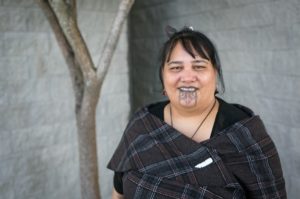
Herearoha holds a senior leadership role at the University of Waikato, is Director of Te Ara Tupu Ltd (business), serves as Trustee for Ngāti Tamaterā Treaty Settlement Trust (iwi), GH Tawhai Trust (whānau), recently appointed to two boards, Ngāti Pāoa Iwi Trust & Te Whāriki Manawāhine o Hauraki, and sits on several governance boards representing iwi as a Treaty partner. She has extensive networks with community organisations, business sector, and government agencies throughout Aotearoa, and Indigenous communities internationally. She specialises in strategy, business development, leadership transformation, governance, finance, transformative praxis, policy, and te reo Māori revitalisation.
Herearoha manages major research projects in the fields of Taiao, Hauora, Mātauranga, and te Reo Māori. She provides leadership in kaupapa Māori research that promote the vision, values, and aspirations of whānau, hapū, iwi. She brings with her a suite of skills and experience to lead an exciting era of transformation through mātauranga and working with Māori practitioners.
 Is a grandmother and researcher. She works for Te Atawhai o te Ao, an independent Māori research institute in Whanganui the organisation which she co-founded. She also works for her Iwi Te Runanga o Ngā Wairiki/Ngāti Apa in Marton. She has 25 years Kaupapa Māori research experience and has led major research projects in the last 15 years on Māori Intergenerational Trauma and Healing, Whakatika: Maori experiences of racism. She works for her iwi managing the research unit and holds Iwi positions on Hauora a Iwi, for the DHB and also is on the board of Te Oranganui, the whanau ora provider in Whanganui. She has been acknowledged by the Royal Society for her contribution to community research through being awarded Te Tohu Rangahau in 2020. She currently holds an advisory position for the Ministry of Health.
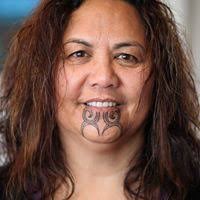
Rihi has been working in the kaupapa Māori research space for over a decade committing her research ideas and knowledge to developing and empowering whānau and Māori communities to grow and maintain their agency by facilitating and building capability skills through kaupapa Māori research informed initiatives. As an experienced therapist Rihi has worked alongside Whānau groups to develop and strengthen whānau oranga and (health and well-being) tikanga practices. Historically Rihi has had many years within the social services sector supporting Māori strategic development that has linked Iwi Hauora and Whānau Ora plans to government funding and resourcing.
 Shirley Simmonds is a mother of two young sons, Tamihana and Raukawa. She works as a Kaupapa Māori Health Researcher based in the rohe of Tauranga Moana, Aotearoa.
Dedicated to raising her children in te reo Māori with the values passed on to us by our ancestors, Shirley and her whānau have a strong focus on living as kaitiaki of our environment.
 An artist, poet, and a visionary, she is the Vice Chair of the International Indian Treaty Council, and is a representative for the Nuclear Free and Independent Pacific Movement.
Hinewirangi teaches in Aotearoa and abroad, conducting workshops on all aspects of Māori philosophies of mental, physical, and spiritual well-being. Her areas of expertise include tradional Māori parenting and healing using music, Taonga Puoro to ‘Singing the sould back into being’. She comes from a ‘Lived Experience’, and uses those lived experiences to help heal men, women, and children.
Mauri ora na Tōna whānau i tuhi.
 Ngaropi is the foundation member, Director and Senior Domestic Violence Programme Facilitator and Educator of Tu Tama Wahine o Taranaki. Ngaropi has worked in the social service area in a variety of environs for over 30 years. Throughout this time, she has been involved in numerous local and national community development projects implementing a variety of kaupapa Māori services, trainings and resources. Ngaropi was the only ACC accredited Māori sexual abuse counsellor for Taranaki for 15 years, is a former member of the Ministry of Justice Domestic Violence Programme Approvals Panel 2002 - 2011, and former member of Māori Advisory Board National Taskforce on Family Violence.
 My previous experience has been across both Government Agencies and NGO’s in Waikato, Taranaki and predominantly Ōtautahi. My last role as a senior probation officer, required one on one long term management of high-risk sex offenders. I am a current member of the National Body of Te Ohaakii a Hine where I am a part of Ngā Kaitiaki Mauri. The organisation comprises of NZ agencies who specialize in Sexual Violence. These experiences have led to my current role as kaiwhakahaere of Te Puna Oranga in Ōtautahi, a kaupapa Māori organisation which focuses on mahi tūkino/sexual violence and the healing of whānau using kaupapa Māori tools.
 Bonnie Duran is a Professor in the Schools of Social Work and Public Health at the University of Washington (UW), in Seattle. Before, during and after completing her doctoral degree at the UC Berkeley, she has worked in public health and social care research, education and practice with a focus on Native Americans/Indigenous peoples and other communities of color for over 35 years. Dr Duran has conducted primary and secondary data analysis studies of mental disorder prevalence, risk and protective factors, victimization, and treatment seeking/ barriers to care among people attending Indian Health Service (IHS) facilities and probability samples from the Tribal Colleges and University’s within the largest rural Tribal Nations in the U.S. In partnership with communities, she has adapted and developed Indigenous interventions for system level, community and individual health and wellbeing.
Another aspect of Dr. Duran’s empirical work is the development of indigenous theory and Community-Based Participatory Research (CBPR) methods. She has pioneered the development and application of CBPR and other forms of Community-Engaged Research (CEnR) and has helped to articulate and disseminate the theory of “Historical Trauma”.
For the past 12 years she has worked in close partnership with the American Indian Higher Education Consortium and Tribal College faculty, staff and students to conduct Indigenous culture-centered epidemiology and interventions research to enhance college success. Dr. Duran is currently co-chair of the Indigenous Expert Panel of the NIAID Coronavirus Prevention Network (CoVPN) and is on a UW COVID-19 Vaccine Trial research team.
The overall goals of Bonnie’s research and practice are to work in partnership with communities to design treatment and prevention efforts that are effective, empowering, sustainable, and that have maximum public health impact.
Dr. Duran is also a Buddhist Mindfulness practitioner and teacher. She teaches long and short retreats and advanced programs at the Insight Meditation Society (IMS) in Massachusetts, and Spirit Rock Meditation Center (SRMC) in California and is on the SRMC Guiding Teachers Council.